| Literacy:
Where to find reading help for a child |
|
|
Choose a topic to
begin or scroll down the page:
|
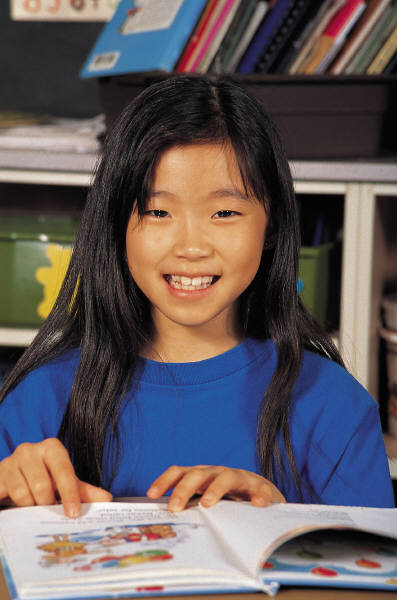
Free Publications: Shining Stars Series
- These free publications from EdPubs show how Parents can
help toddlers thru children in the 3rd grade level learn to read.
To order, download or view, visit
http://edpubs.ed.gov/
and enter "Shining Stars" in the search box near the top of
the page.
A Different Kind of Home
Schooling - The son of poor
laborers in rural Mexico, Ocario Gonzalez doesn't remember his
parents ever helping with his schoolwork. After struggling with his
studies for a few years, Gonzalez left school at 12. Now the
42-year-old South Los Angeles factory worker is trying to break that
cycle with his daughter, Carolina. |
|
Kindergarten
- Third Grade Literacy |
|
With
Help, Kids Keep Reading After Age 8 - Some 92 percent of
children enjoy reading books for fun, but their reading time takes a
steep dive after age 8. The main cause: They can't find books they
like and parents aren't helping them with book selection as much as
they did when the kids were small.
A Page Turner For Parents Who Want Their Child To Read - Anyone
who has struggled to help a child learn to love books will find
"Deconstructing Penguins" full of new ideas.
Lansing Educators Take
Reading Tools on the Road - Door-to-door visits part of plan to
help struggling students. Lansing parents, be aware: If your child is
in kindergarten or first-, second- or third-grade, an educator may
come knocking on your door. Ingham County's largest school district
formally introduced a new door-to-door initiative last week called,
"On the Road for Reading." It requires several educators to spend a
half-day per week visiting homes of young struggling readers.
Partnership For Reading - The Partnership for Reading is
offering free literacy resources for educators, teacher educators,
administrators, policymakers, support agencies and families. Among the
resources now available are: a new booklet for parents to help their
children in grades K-3 become successful readers; a book geared to
parents of children from birth through preschool; and a guide to help
teachers become discerning consumers of education programs and
materials. All of these documents and more can be downloaded for free.
[Source: PEN]
|
|
 Put
Reading First
Helping Your Child Learn to Read - A Parent Guide
This brochure, designed for
parents, provides a quick overview of the findings of the National
Reading Panel and gives ideas for what to expect from a school's
reading program based on evidence from the research (preschool through
grade 3). The brochure also suggests ways parents can reinforce
reading instruction at home with everyday activities and interactions.
Download this document --
PDF or
HTML (accessible format) or order this
document in print
edpuborders@edpubs.org |
 A Child Becomes
a Reader A Child Becomes
a Reader
Proven Ideas for Parents from Research--Kindergarten through Grade
Three
The road to becoming a reader begins the day a child is born and
continues through the end of third grade. At that point, a child must
read with ease and understanding to take advantage of the learning
opportunities in fourth grade and beyond. This booklet offers advice
for parents of children from grades K-3 on how to support reading
development at home, and how to recognize effective instruction in
their children's classrooms.
Download the color PDF version;
black and white PDF version;
HTML (accessible format); or order this document
edpuborders@edpubs.org |
|
 Put
Reading First Put
Reading First
The Research Building Blocks for Teaching Children to Read
This 64-page booklet
provides teachers with a summary of the findings of the National
Reading Panel from its review of reading research. Organized by major
reading topic for kindergarten through grade 3 (phonemic awareness
instruction, phonics instruction, vocabulary instruction, fluency
instruction, and text comprehension instruction), the booklet lists
the main findings from the research, suggests how the findings can be
translated to practice, and answers some frequently asked questions
about each topic.
Download this document --
PDF or
HTML (accessible format) or order this
document in print
edpuborders@edpubs.org |
|
back to
the top
|
|
Featured
Websites |
|
Featured Resource:
BookCrossing.com -
Looking for a break from the doldrums of creating yet another
e-commerce website (that's just what the world needs), or email server
application (oooh, those are doubly exciting), Ron Hornbaker sought to
create a community site that would be the first of its kind, that
would give back to the world at large, and that would provide warm
fuzzy feelings whenever he worked on it. BookCrossing.com was the
result, a website that encourages everyone to “release” their favorite
books “into the wild” and then track the books’ travels worldwide.
Red Flag Screening - Give your child
an informal reading test to help evaluate his/her level of reading
accuracy. The test is based on materials from the State of Texas. "Our
screening is designed to provide parents with a tool that can help
confirm or negate their suspicions, through the use of objective &
widely accepted standards as applied to state approved grade level
material. The results of the screening can then be used as one more
piece of the puzzle in determining whether to seek further help or
testing."
Featured Website:
Free Phonics Lessons Online
Jel Publishing:
Books Designed for
Children with Disabilities
Scientific
Learning: A new way to learn - The Fast ForWord family of products
develops the critical thinking, listening, and reading skills that are
necessary for success in the classroom, the workplace and in everyday
life. The Fast ForWord family of products use neuroscience principles
to create an optimal learning environment that enables you to:
Simultaneously develop multiple skill sets to maximize learning,
Identify reading and language difficulties, and Attack the underlying
causes of these difficulties.
The
Adolescent Literacy Web Topic is packed full of research-based
information on literacy and is now available on the National Center on
Secondary Education and Transition (NCSET) Web site.
America's Literacy
Directory:
Where to find Reading & Literacy Help for Children
- click here.
America's Literacy
Directory:
Where to find
Reading & Literacy Help for Adults -
click here.
Starfall
-
Help your child learn to read; includes free reading activities!
|
|
back to
the top
|
|
Articles About
Literacy |
|
Retired Teacher
Reveals He Was Illiterate Until Age 48 - John Corcoran graduated from
college and taught high school for 17 years without being able to read, write or
spell.
Curriculum Helps Jolt
Reading Skills - A Hickman Mills High student earns national honors for
the improvements he has shown with Read 180. Kevin Bowen was a floater, one of
those students who drift into high school reading no better than a third-grader.
But now the 15-year-old Hickman Mills High School freshman is an all-star, one
of nine students in a nationwide spotlight for their dramatic reading gains. The
recognition came from publishing giant Scholastic Inc. It developed the Read 180
curriculum credited with turning Kevin into a ninth-grade reader within a matter
of months. Some local districts are spending upwards of half a million dollars
on the program--and that doesn't even include personnel costs. But
administrators swear by its results.
Parents Learn Alongside Kids in Literacy Program - Jose Perez is a
fidgety 5-year-old and his teacher changes activities often to accommodate his
attention span. Yesterday, his mother, Sylvia, was at his left elbow for 40
minutes, coaching him to put space between words, erasing mistakes, helping him
with vocabulary. Harborside Elementary School lured his mother onto campus by
enrolling her as a student at the kindergarten through sixth-grade school.
Before she became a Harborside pupil, Sylvia Perez did not set foot on campus.
The extent of her involvement was giving her children rides to and from school.
Interview:
Dr. Mel Levine - All Kinds of Learning - In
this Children of the Code interview,
Dr. Levine discusses his work at All Kinds of Minds and engages in a wide
ranging dialogue about the many dimensions of learning. Of particular interest
to COTC readers, Dr. Levine discusses how the effects of reading difficulty can
ripple through learning in general.
Tips on Picking Audio Books - Here are some tips for
choosing audio books for children, suggested by Shannon Maughan, audio
book expert at Publishers Weekly, and Sharon Grover, youth services
librarian in Arlington, Va.
The Personal and Social Implications of Literacy and Literacy Instruction -
Interview with Dr. Shanahan who is currently chair of the National Early
Literacy Panel. Dr. Shanahan is an internationally recognized reading researcher
with extensive experience with children in Head Start, children with special
needs, and children in inner-city schools. During the course of over five hours
of conversations, spread across three interviews, we found Dr. Shanahan to be an
open minded and well rounded literacy expert whose driving passion is to serve
children and families. He is without doubt one of the least partisan and most
noble champions of children and literacy we have encountered.
The Scream!
Does Children’s Literature Have to Be Scary? - It is as though the
authors, the publishers, the teachers, and the professors of education share a
bizarre consensus that ordinary children need to be shaken out of their
complacency, stripped of their innocence, and frightened by the horrors that the
world has in store for them at any moment. What Feinberg nicely exposes is that
the entire field of children’s literature specialists has bought a flawed bill
of goods and has sold it to the nation’s teachers. They have persuaded
themselves that their job is not to promote excellent literature, but to promote
depressing problem novels. In doing so, they seem to be turning young people
away from literature in droves.
|
|
back to
the top
|
|
Literacy-related Resources
& Tools |
|
Resource from a parent: Parenting a Struggling
Reader: A Guide to Diagnosing and Finding Help for Your Child's
Reading Difficulties by Susan Hall & Louisa Cook Moats
- You can read an excerpt from chapter 1 on the Barnes
& Noble website if you search under the book
title and then "click"
on the book title. You
then have an option to "click"
to read an excerpt. Among the many things covered in the book
are "central linguistic processing" issues.
Visit
www.barnesandnoble.com for more information.
Literacy screening
tool for 4-year-olds:
http://www.familyeducation.com/article/0,1120,63-25466,00.html
Family Literacy: A Strategy for Educational Improvement
-
There is an overwhelming relationship between parental
education levels, parental involvement, and children's school success.
Family literacy directly affects the role and effectiveness of parents
in helping their children learn. Click
here to download the pdf brief (size=222kb).
C-A-T
= CAT Online Phonics/Learn to Read Module - This
online book/module is available for free online. "I
think that the sounds available on the site (that coincide with each
letter) is a very nice touch. It is a humble
approach to phonics from the UK."
(JDI)
Ohio
Department of Education:
Choosing a Reading Program: A Consumer's Guide
(PDF) - Descriptions and evaluations of 21
programs used in Ohio elementary schools.
|
|
back to
the top
|
|
Literacy
Organizations & Websites |
|
Directory of National and State Literacy Contacts
- Locate literacy programs in your state. The National
Institute for Literacy (NIFL) is a federal organization that shares
information about literacy and supports the development of
high-quality literacy services so all Americans can develop essential
basic skills.
|
|
 |
|
 Reading Is
Fundamental (RIF)
- Reading Is Fundamental, Inc.
prepares and motivates children to read by delivering free books and
literacy resources to those families who need them most. RIF
operates through a network of 435,000 volunteers and gives away 16
million books a year at more than 23,000 sites nationwide. These sites
include schools, libraries, community centers, child-care centers,
hospitals, migrant worker camps, Head Start and Even Start programs,
homeless shelters, and detention centers. Reading Is
Fundamental (RIF)
- Reading Is Fundamental, Inc.
prepares and motivates children to read by delivering free books and
literacy resources to those families who need them most. RIF
operates through a network of 435,000 volunteers and gives away 16
million books a year at more than 23,000 sites nationwide. These sites
include schools, libraries, community centers, child-care centers,
hospitals, migrant worker camps, Head Start and Even Start programs,
homeless shelters, and detention centers.
National Center for Learning Disabilities (NCLD)
http://www.ncld.org/ld-basics/research-roundup
Get Ready to Read website (an initiative of the NCLD):
http://www.getreadytoread.org/linguis.html#
Internet Special Ed:
http://www.iser.com/index.shtml
|
|
back to
the top
|
|
Literacy
Hotlines |
|
National Literacy
Hotline 1-800-228-8813
The National Literacy Hotline has a 24-hour bilingual
(Spanish/English) operator service that provides information on:
literacy/education classes, GED testing services, volunteer
organizations, and a learning disabilities brochure.
|
|
back to
the top
|
|
|
|