|
Proof is Scant
on Psychiatric Drug Mix for Young
Gardiner Harris, New York Times, November
23, 2006
Their rooms are a mess, their trophies line
the walls, and both have profiles on MySpace.com. Stephen and
Jacob Meszaros seem like typical teenagers until their mother
offers a glimpse into the family’s medicine cabinet.
Bottles of psychiatric medications fill the shelves. Stephen,
15, takes the antidepressants Zoloft and Desyrel for depression,
the anticonvulsant Lamictal to moderate his moods and the
stimulant Focalin XR to improve concentration. Jacob, 14, takes
Focalin XR for concentration, the anticonvulsant Depakote to
moderate his moods, the antipsychotic Risperdal to reduce anger
and the antihypertensive Catapres to induce sleep.
|
 |
|
"We always debate meds," said Billy
Igafo-Te'o. Mr. Igafo-Te'o is the father of Michael Igafo-Te'o,
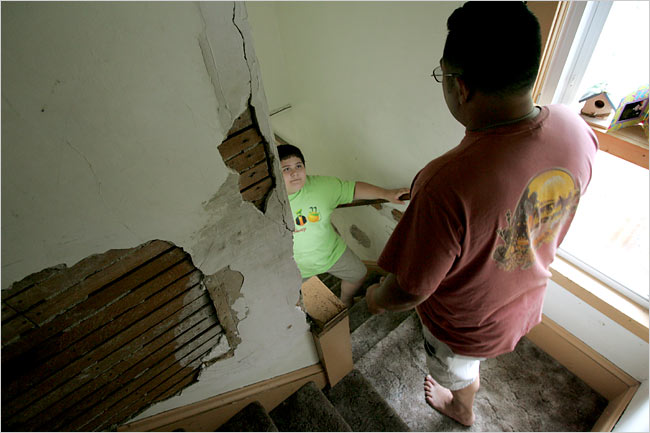
12, who takes four drugs and has damaged their home so often
that they no longer repair it.
|
Over the last three years, each boy has been
prescribed 28 different psychiatric drugs.
“Sometimes, when you look at all the drugs they’ve taken, you
wonder, ‘Wow, did I really do this to my kids?’ ” said their
mother, Tricia Kehoe of Sharpsville, Pa. “But I’ve seen them
without the meds, and there’s a major difference.”
There is little doubt that some psychiatric medicines, taken by
themselves, work well in children. For example, dozens of
studies have shown that stimulants improve attentiveness. A
handful of other psychiatric drugs have proven effective against
childhood obsessive compulsive disorder, among other problems.
But a growing number of children and teenagers in the United
States are taking not just a single drug for discrete
psychiatric difficulties but combinations of powerful and even
life-threatening medications to treat a dizzying array of
problems.
Last year in the United States, about 1.6 million children and
teenagers — 280,000 of them under age 10 — were given at least
two psychiatric drugs in combination, according to an analysis
performed by Medco Health Solutions at the request of The New
York Times. More than 500,000 were prescribed at least three
psychiatric drugs. More than 160,000 got at least four
medications together, the analysis found.
Many psychiatrists and parents believe that such drug
combinations, often referred to as drug cocktails, help. But
there is virtually no scientific evidence to justify this
multiplication of pills, researchers say. A few studies have
shown that a combination of two drugs can be helpful in adult
patients, but the evidence in children is scant. And there is no
evidence at all — “zero,” “zip,” “nil,” experts said — that
combining three or more drugs is appropriate or even effective
in children or adults.
“There are not any good scientific data to support the
widespread use of these medicines in children, particularly in
young children where the scientific data are even more scarce,”
said Dr. Thomas R. Insel, director of the National Institute of
Mental Health.
Psychiatrists who prescribe drug combinations say that the
ability to mix and match medications improves their chances of
being able to help children who are seriously, even desperately,
ill.
Dr. Joseph Biederman, a professor of psychiatry at Harvard, said
that doctors commonly used multiple medicines to treat heart
disease, diabetes, cancer and AIDS. “Child psychiatry is not any
different,” Dr. Biederman said. “These drugs have revolutionized
how we treat severe psychopathology in children.”
The controversy leaves parents in a terrible bind. Desperate to
help, many agonize over whether to medicate their children.
Mothers and fathers sometimes disagree, with the dispute
straining or even ending marriages. Since some psychiatric drugs
can cause worrisome physical effects, parents say that they must
on occasion make a terrifying choice between their child’s
physical health and his mental health.
The parents interviewed for this article told their stories,
they said, in hopes of gaining greater acceptance for their
children and themselves. Nearly all recalled being in a store
when their child threw a tantrum and feeling that onlookers
branded them as bad parents. They also said they hoped to help
others negotiate what many said were unequal and often fraught
relationships with psychiatrists.
“We struggled so much, made so many mistakes and felt so
stigmatized, I hope our story can make it easier for others,”
said Jacquie Erickson of Anchorage. Her daughter, Kaitlyn
Johnston, 10, has taken psychiatric drugs since she turned 5 for
diagnoses that include bipolar disorder.
On Shaky Ground
Stimulants like Ritalin are by far the most commonly prescribed
psychiatric medicines in children. But doctors routinely pair
stimulants with antidepressants, antipsychotics and
anticonvulsants, even though some of these medications can cause
serious side effects, have few proven pediatric psychiatric
benefits and lack clear evidence about how they interact or
influence mental and physical development.
Last year, the Food and Drug Administration required drug makers
to warn on their labels that antidepressants can cause suicidal
thoughts and behavior in some children. Anticonvulsant drugs
carry warnings about liver and pancreas damage and fatal skin
rashes. The side effects of antipsychotic medicines can include
rapid weight gain, diabetes, irreversible tics and, in elderly
patients with dementia, sudden death. When drugs are combined,
these risks compound.
Ms. Kehoe, who receives government financial and child-care
assistance because her children are considered mentally ill,
said she knew that there were risks to the drug cocktails. Both
her sons are short and underweight for their age — a common side
effect of stimulants — and she fears that the drugs have
affected their health and behavior in other ways.
“But I don’t think the insurance would pay for it if the F.D.A.
didn’t decide that children should use it,” said Ms. Kehoe, who
herself takes psychiatric medication.
In fact, the drug agency has specifically warned against the use
of Lamictal, one of the drugs Stephen takes, in children who,
like him, do not suffer from seizures because in 8 out of 1,000
children the drug causes life-threatening rashes.
Stephen and Jacob’s psychiatrist did not reply to telephone
messages left with an office secretary on three different days.
Ms. Kehoe said that she asked him to speak to this reporter but
that he refused. The boys have had 11 psychiatrists over the
last three years, according to prescription records, and many
more before that, Ms. Kehoe said.
In interviews, Stephen and Jacob said they hated taking their
drug cocktails.
“Everybody hates meds,” Jacob said.
Ms. Kehoe said her youngest son, Lucas Keck, was showing signs
of attention deficit disorder and might soon need to start
medication.
“I see the hyperness in him,” she said. “My pediatrician has
said that he would venture to say that Lucas will be A.D.H.D.”
Stephen and Jacob were Lucas’s age — 6 — when they were given
their first prescriptions.
The F.D.A. requires drug makers to prove that their drugs work
safely before the agency will approve them for sale in the
United States. But doctors can prescribe and combine approved
medicines as they see fit. Such mixing is common in medicine but
rarely studied by drug makers.
Psychiatrists started mixing psychiatric medications because the
drugs were only moderately effective and often caused terrible
side effects, said Dr. Steven E. Hyman, the provost of Harvard
University and former director of the National Institute of
Mental Health. “None of these drugs by themselves do an adequate
job of controlling symptoms,” Dr. Hyman said.
If one drug failed, many psychiatrists assumed that two or more
drugs used together might succeed. For decades, no one studied
whether this was accurate. But in recent years, a trickle of
studies have examined the question, with mixed results.
In studies in adults, some combinations of two drugs have been
shown to work better than single medications to improve the
symptoms of depression, obsessive-compulsive disorder and the
mania associated with bipolar disorder. For example, a recent
large government-financed study in adults, published in The New
England Journal of Medicine, found that two antidepressants
worked a bit better than one for adults who suffered from
chronic, severe depression. But other studies have found no
benefit from commonly prescribed drug combinations.
The use of two-medicine combinations in children is on much
shakier ground. Even for single drugs, the effectiveness of some
psychiatric medications in younger patients is questionable:
most trials of antidepressants in depressed children, for
instance, fail to show any beneficial effect. But hardly any
studies have examined the safety or the effectiveness of
medicine combinations in children. A 2003 review in The American
Journal of Psychiatry found only six controlled trials of
two-drug combinations. Four of the six failed to show any
benefit; in a fifth, the improvement was offset by greater side
effects.
“No one has been able to show that the benefits of these
combinations outweigh the risks in children,” said Dr. Daniel J.
Safer, an associate professor of psychiatry at Johns Hopkins
University and an author of the 2003 review.
If the evidence for two-drug combinations is minimal, for
three-drug combinations it is nonexistent, several top experts
said.
“The data is zip,” Dr. Hyman said.
Many psychiatrists said that they turned to drug cocktails only
in desperate circumstances. “If you’ve got a 15-year-old who is
cutting up her arms, you’ve got a barn on fire and what are you
supposed to do?” asked Dr. Alexander Lerman, a child and
adolescent psychiatrist in New York, who said he rarely
prescribed combinations.
Billy and Jackie Igafo-Te’o
of Jackson, Mich., are among the desperate. In the last seven
years, their 12-year-old son, Michael, “has been on just about
everything you can put a child on,” Mrs. Igafo-Te’o said. He is
now taking four medications: an antipsychotic, an
anticonvulsant, an antidepressant and a sleep medicine.
Despite the medications, Michael’s behavior has grown
increasingly disruptive. He has kicked and punched holes in
almost every wall of the Igafo-Te’o home. He wrenched the sink
off the wall in the upstairs bathroom and pulled two bedroom
doors off their hinges, damaging the frames. The family no
longer fixes the damage.
During a recent visit, Michael and Mr. Igafo-Te’o were sitting
on the living-room floor. Michael wanted the phone. His father
held it out of reach to prevent Michael from playing with it.
Michael became increasingly desperate. He cried. He cursed.
“That’s it, you have a timeout,” Mr. Igafo-Te’o said.
“No, no, no,” Michael answered. “You pimp!”
He slapped his father in the face, hard. Mr. Igafo-Te’o hustled
Michael into the kitchen and forced him to sit for 20 minutes.
“What’s the purpose of all this medication if I still have to do
that?” Mr. Igafo-Te’o asked.
He said he wanted to end Michael’s drug therapy. Among other
side effects, the drugs have made Michael obese, which has led
to asthma.
Mrs. Igafo-Te’o quietly disagreed. “I’m afraid he wouldn’t be
able to focus,” she said. “I’m afraid he would regress
socially.”
“Regress socially? Look at him!” her husband responded,
motioning to their son, crying uncontrollably on the kitchen
floor.
“I have to believe in something,” his wife mumbled and walked
out of the room.
Mr. Igafo-Te’o watched her go and then smiled apologetically.
“We always debate meds,” he said.
Divergent Views
Most experts agree that some children are so violent or suicidal
that a combination of psychiatric drugs is worth trying. But
recently, more psychiatrists have been asking whether in some
cases drugs are being prescribed for children who do not need
them, or for problems that fall within the spectrum of normal
behavior. The doubters are especially concerned with the growing
use of drug combinations for preschoolers.
Fate Riske, 3, of Fond du Lac, Wis., takes two antipsychotics
and a sleeping medicine to control what her mother, Elizabeth
Klein-Riske, said were hours-long tantrums, a desire to watch
the same movies repeatedly and an insistence on eating the meat,
cheese and bread in her sandwiches separately.
On a recent visit, Fate played sweetly for four hours as her
parents, who both have trouble walking, sat in front of a
television. Sucking on a pacifier, Fate showed off her pink
dress and matching shoes.
Mrs. Klein-Riske credited the drugs for Fate’s cherubic behavior
during the visit. But a few weeks on a different antipsychotic
led Fate to become aggressive, talk rapidly and “run around
wild, totally out of control,” said Mrs. Klein-Riske, who
receives government financial and child-care assistance because
her daughter is considered mentally ill.
Fate’s weight ballooned in five months to 48 pounds from 30.
Dr. Gary Sachs, director of the Bipolar Clinic and Research
Program at Massachusetts General Hospital in Boston, estimated
that half the children referred to his clinic for research in
recent years — including many who took drug combinations — had
the wrong diagnosis and often did well on fewer drugs. “Even
among properly diagnosed bipolar patients, many come to our
program already taking medicines that interfered with each
other,” Dr. Sachs said.
But Dr. Judith Rapoport, a senior investigator in child
psychiatry at the National Institute of Mental Health, said that
in her experience, few children were overmedicated. Dr. Rapoport
studies children with schizophrenia. Before entering her study,
children must be drug-free for three weeks.
“We’ve had a handful of cases who are completely normal when
they get off drugs,” Dr. Rapoport said. “But most of these kids
become very, very sick and unmanageable without drugs.”
The first psychiatric problem diagnosed in most children is
attention deficit disorder, treated with stimulants — drugs that
improve attentiveness. But when children’s problems persist,
parents’ relatively good experience with stimulants often
convinces them to agree to try other medicines — in some cases
drugs like the antipsychotic Risperdal or the anticonvulsant
Depakote that have few proven benefits in children and greater
dangers, said Dr. Ranga Krishnan, chairman of the department of
psychiatry and behavioral science at Duke University.
“After you get them on one drug, parents don’t seem to mind the
second,” said Dr. Krishnan, who said that he had grave doubts
about the growing use of psychiatric drug cocktails in children.
Antidepressants are commonly paired with stimulants, but
antidepressant use has declined over the last year after the
F.D.A. warning about suicide risk. In their place, physicians
are prescribing combinations that include antipsychotic and
anticonvulsant drugs, according to Medco. From 2001 to 2005, the
use of antipsychotic drugs in children and teenagers grew 73
percent, Medco found. Among girls, antipsychotic use more than
doubled.
On Again, Off Again
Andrew Darr of Caldwell, Idaho, whose sons took medications,
said that he was opposed to it from the start. “When you come
home from work and instead of getting them clawing at your feet
and yelling, ‘Daddy, Daddy,’ you get a lethargic grunt, it just
kills you,” Mr. Darr said.
His wife, Leslie Darr, eventually agreed to stop the medicines,
but only after a family tragedy.
The Darrs have four children, Nicholas, 16, Nathan, 15, Becky,
12, and Benjamin, 9. At 3, Nicholas suffered a mild brain injury
when undiagnosed appendicitis led him to suffer weeks of high
fever, Mrs. Darr said.
Mrs. Darr said that she was pressured by school officials to
give Nicholas a stimulant at age 6. Nathan soon followed.
Three years later, the boys had a traumatic weekend away with
relatives. A month after that, Mrs. Darr said, both were
hospitalized for a week and given a diagnosis of bipolar
disorder and prescriptions for antipsychotic, antidepressant and
sleeping medicines.
Over the next three years, Nicholas’s weight ballooned to 140
pounds from 52. Nathan went to 115 pounds from 48. Neither boy
got much taller, Mrs. Darr said. They did poorly in school.
Then Becky developed a brain tumor. A nurse practitioner gave
Mrs. Darr free samples of an antipsychotic drug to help her
cope. After starting it, she said, she could not sleep or think
straight. She realized that she had been giving similar
medicines to her sons for years and she decided to wean the boys
off the pills.
Their behavior immediately worsened. At one point, Nicholas left
the house during a blizzard wearing only boxer shorts, Mrs. Darr
said. They found him in a tire swing saying, “Baaa.”
“There were several times that we almost gave up,” Mr. Darr
said.
But after four months off medication, the boys’ behavior
normalized, the Darrs said, and they were transferred out of
special education and into regular classes. The Darrs recently
allowed the boys to spend their first evening at a mall without
supervision, and in July they gave both boys their first
bicycles. “They’ve come a long way,” Mrs. Darr said.
In an interview, Nicholas said the drugs “were not cool.”
“You go to school and everybody thinks, ‘Look at that retard,’ ”
he said.
Still, most of the parents interviewed for this article said
their children’s behavior deteriorated rapidly without
medication.
Joanne Johnson of Hillsborough, N.J., described a psychiatrist’s
effort to wean her 17-year-old son, Brad, off of all five of his
psychiatric medicines as “the biggest mistake of our lives.”
Brad, then 13, became suicidal and was hospitalized for weeks,
Ms. Johnson said.
“He went into the hospital on five drugs and came out on five
different ones, but he was unstable,” she said. “It took a
little over two years to find the right match again.”
Brad is now taking lithium, an antipsychotic, an anticonvulsant,
an antidepressant, a stimulant and a sleeping pill.
“He’ll probably be on these for the rest of his life,” Ms.
Johnson said.
back to the top ~
back to Breaking News
~ back to
What's New
|